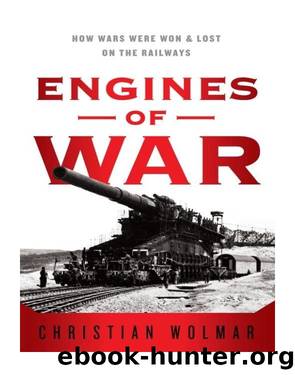
Engines of War by Christian Wolmar
Author:Christian Wolmar
Language: eng
Format: epub
Publisher: PublicAffairs
Published: 2010-10-19T16:00:00+00:00
SEVEN
THE GREAT RAILWAY WAR ON THE WESTERN FRONT
The Germans did not get to Paris in thirty-nine days. Or in fact ever. The Schlieffen Plan did not work and generations of historians have subsequently analysed its shortcomings. Moltke took the rap and soon resigned but it was the inherent failings of the plan, not his tinkering, which led to its undoing. Neither can blame for its failure be laid at the door of the German railways. They had been taken over, as envisaged, by the military authorities, who, despite being at times âoverzealous and overbearingâ,1 carried out the task of mobilization remarkably efficiently. On 4 August, the long-prepared war timetables were introduced, which greatly limited any traffic other than military. The first trains to be despatched carried infantry brigades destined for the capture of Liège, the vital Belgian railway junction in the Meuse Valley, and over the following two weeks 3 million soldiers were carried by the railways in more than 11,000 trains. Yet, according to John Westwood, ânevertheless, the German railways were never extended to their full capacity during this period; they could have carried even more traffic.â2 There were, though, enormous bottlenecks on the Belgian railways, notably in Liège, through which much of the attack was funnelled.
The plan failed because of its strategic and logistical flaws. Not only was it based on the mistaken assumption that the Belgians would surrender without a fight and keep their railways intact, but it expected too much of the troops on the right flank, who were supposed to march much further than was realistic if they were to be in a fit state to fight. In fact, after the failure of German diplomatic negotiations â which had all the subtlety of an armed bank robber demanding the money from a terrified teller â Albert, the Belgian king, ordered the destruction of railway tunnels and bridges even before the first German troops had set foot in his country. Consequently, the Belgians set about disabling their railway system with ruthless efficiency, concentrating on blowing up the tunnels to prevent any hope of rapid repair. After the invasion, the Germans deployed large numbers of men, a force of 26,000 workers, to try to sort out the broken railways but to little avail. Even a month after the German occupation of Belgium at the onset of the crucial battle of the Marne in early September, only a sixth of the 2,400-mile Belgian rail network was functioning. Moreover, the surviving lines were in a poor state. Most of the rolling stock had been destroyed or taken to France by the Belgians, and even where the track had been left intact, signalling equipment was sabotaged. The Belgians also indulged in the kinds of tricks deployed the world over by reluctant railway workers, such as routing trains onto the wrong lines at junctions or âmistakenlyâ sending them into sidings.
The destruction of the Belgian railways delayed the progress of the German troops but did not entirely put paid to the Schlieffen Plan.
Download
This site does not store any files on its server. We only index and link to content provided by other sites. Please contact the content providers to delete copyright contents if any and email us, we'll remove relevant links or contents immediately.
Whiskies Galore by Ian Buxton(42078)
Introduction to Aircraft Design (Cambridge Aerospace Series) by John P. Fielding(33175)
Small Unmanned Fixed-wing Aircraft Design by Andrew J. Keane Andras Sobester James P. Scanlan & András Sóbester & James P. Scanlan(32835)
Aircraft Design of WWII: A Sketchbook by Lockheed Aircraft Corporation(32329)
Craft Beer for the Homebrewer by Michael Agnew(18284)
Turbulence by E. J. Noyes(8112)
The Complete Stick Figure Physics Tutorials by Allen Sarah(7422)
The Institute by Stephen King(7088)
The Thirst by Nesbo Jo(7002)
Kaplan MCAT General Chemistry Review by Kaplan(6986)
Bad Blood by John Carreyrou(6669)
Modelling of Convective Heat and Mass Transfer in Rotating Flows by Igor V. Shevchuk(6495)
Weapons of Math Destruction by Cathy O'Neil(6362)
Learning SQL by Alan Beaulieu(6344)
Man-made Catastrophes and Risk Information Concealment by Dmitry Chernov & Didier Sornette(6138)
Permanent Record by Edward Snowden(5890)
Digital Minimalism by Cal Newport;(5835)
Life 3.0: Being Human in the Age of Artificial Intelligence by Tegmark Max(5617)
iGen by Jean M. Twenge(5453)
